Playbook: Human + Agent Team Design
The Human & Agent Design encourages you to Design the Work Before the Role Panic. The question is not only what AI does but who supervises to catch exceptions.
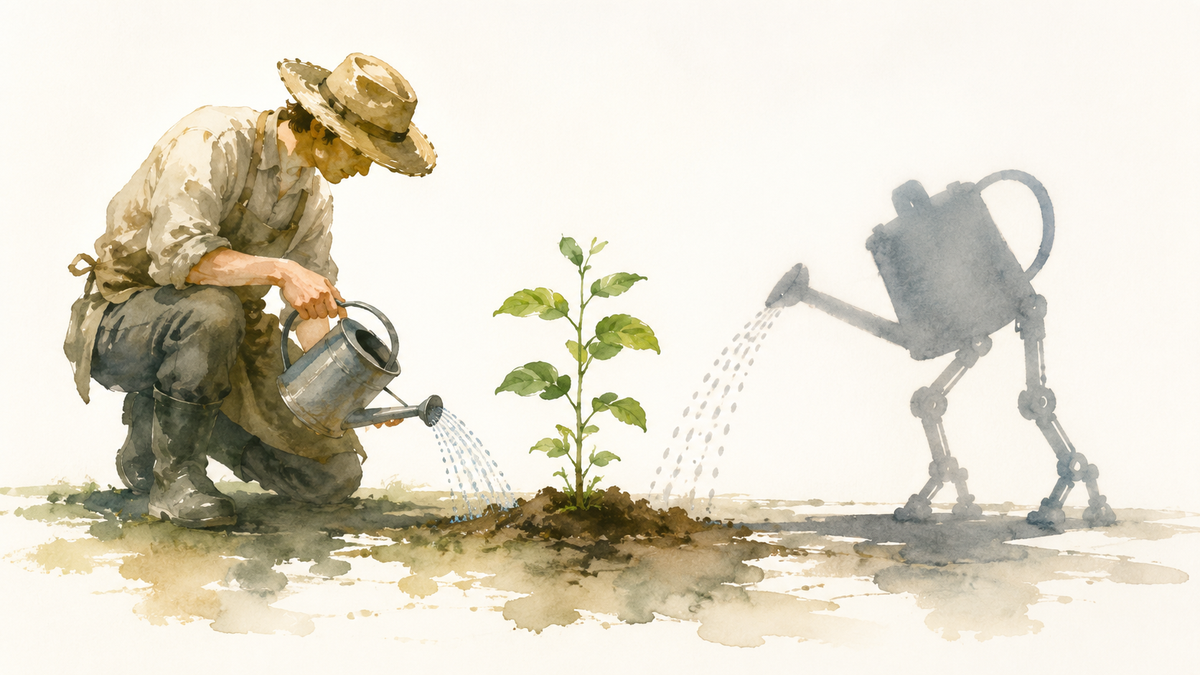
Human + Agent Team Design: Design the Work Before the Role Panic
Use this playbook to design the human-agent team around the workflow before role confusion becomes fear.
In plain English
AI rollout creates anxiety when people cannot see what remains human, what becomes automated, and who is accountable.
The market is talking about job impact, AI operators, and AI coworkers. The practical Operator move is to design work: handoffs, supervision, exceptions, accountability, training, and decision rights.
How this connects to the sequence
The Autonomy Ladder tells you how much action AI is allowed to take. Human + Agent Team Design tells you what the human does around that system.
Signal linked to this playbook
AI does not just automate tasks. It changes supervision.
This Signal reframes role anxiety as supervision design. The question is not only what AI does, but who watches, approves, improves, and catches the edge cases.
The design roles
- Outcome owner: owns the business result.
- Human reviewer: checks AI output before it moves forward.
- Exception handler: resolves cases the system cannot handle.
- Trainer / knowledge steward: improves the content, prompts, examples, and workflow knowledge.
- Operator / supervisor: monitors workflow health and escalations.
- Frontline ambassador: helps real users adopt the new way of working.
Use this when
- People ask whether AI will replace their work.
- A workflow has moved from assist to action.
- Users do not know when to trust or override AI.
- The AI works technically but adoption is poor.
- Nobody knows who trains, supervises, or improves the system.
Design questions
- What does AI do before the human enters?
- What does the human approve?
- What exceptions stay human?
- What knowledge must be maintained?
- What handoffs change?
- What training is needed?
- Who owns failure and improvement?
- What should be stopped or removed from the human workload?
What good looks like
- The human role is clearer after AI, not fuzzier.
- Escalation paths are visible.
- The system reduces effort without hiding accountability.
- The team has a review cadence to adapt the design.
The first move
Pick one AI-enabled workflow. Draw three columns: Human, AI, Shared. Put every step in one column, then mark where approval, exception handling, and learning loops sit.
Human work signal
Human + Agent Team Design is not a job-loss model. It is a work-design tool: who does, who checks, who supervises, who learns, and who owns the outcome.
What to capture in the worksheet
| # | Field | Why it matters |
|---|---|---|
| 1 | Workflow step | Defines where work occurs in the process. |
| 2 | Human role | Clarifies human responsibility & accountability. |
| 3 | AI role | Defines the AI’s contribution to the workflow. |
| 4 | Shared handoff | Ensures smooth coordination between human and AI. |
| 5 | Approval point | Identifies where human judgment is required. |
| 6 | Exception path | Defines how edge cases are handled. |
| 7 | Training need | Prepares users to work effectively with AI. |
| 8 | Owner | Assigns accountability for outcomes and improvement. |
| 9 | Review date | Ensures the design evolves as the workflow matures. |
Get the lightweight workbook
The public playbook gives you the method. The member workbook gives you the simple working sheet across various Playbooks.